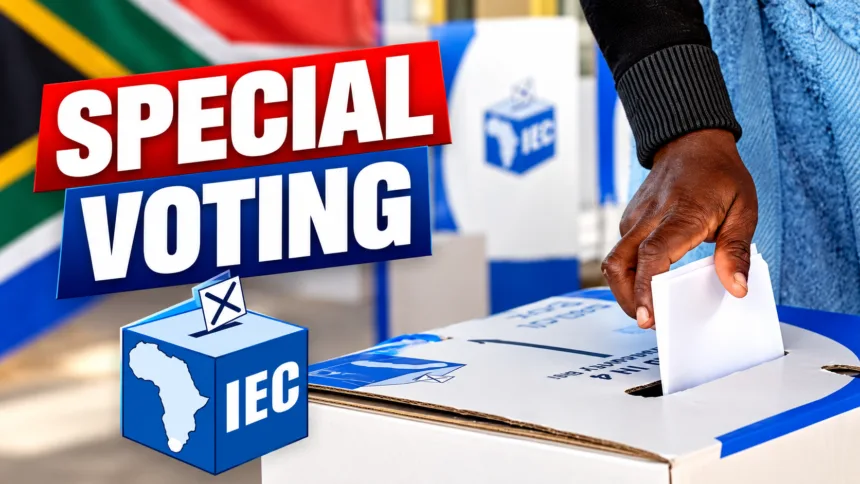
Special voting in South Africa's local government elections begins today, Monday 2 November, and continues tomorrow. The Electoral Commission of South Africa (IEC) approved 2,655,067 special vote applications, and voting runs from 8am to 5pm on both days, ahead of Election Day on Wednesday 4 November, when stations are open from 7am to 9pm, according to the IEC.
The total is 131% higher than the 1,147,759 special votes approved in 2021, IEC chief electoral officer Sy Mamabolo said at a briefing in October.
Who qualifies and how special votes work
There are two kinds of special vote. Home visits are for voters who cannot travel because of illness, disability or infirmity, and IEC officials go to their residences. The IEC approved 678,525 home visits, up 33.7% on the 507,407 approved in 2021, with KwaZulu-Natal accounting for the most at 143,714. The rest, about 1.98 million by our calculation, are voters approved to vote at their station on 2 or 3 November because they cannot do so on 4 November. The IEC has said these include essential services, security services and media workers who expect to be outside their voting district.
Older women dominate the home-visit group. Women made up 74% of home-visit applicants and 64% of station applicants, and voters aged 60 and over were 79.6% of home-visit applicants, according to the IEC. Mamabolo said home visits are “predominantly utilised by older voters, particularly older female voters.” Gauteng (480,721), the Eastern Cape (401,971) and KwaZulu-Natal (348,971) had the most approvals, based on figures captured by 14 October. Applications closed at 17h00 on 12 October and no late applications are accepted.
The IEC says voters must vote at the station where they are registered, and must bring a smart ID card, a green barcoded ID book or a valid temporary identity certificate. Driver's licences, passports, student cards and photocopies of ID are not accepted. Voters can check their registration details at elections.org.za, by sending their 13-digit ID number by SMS to 32810, or by sending “Hi” on WhatsApp to 060 088 0000.
At the station, an official verifies identity and checks the voters' roll, and the voter's thumbnail is marked with indelible ink. Voters in metros receive two ballots, a ward ballot and a proportional representation ballot for the metro council. Voters in local municipalities receive three: ward, local council and district council. The IEC asks voters to make one clear X on each ballot, and to return a spoiled ballot to the presiding officer rather than put it in the box.
Readiness and security
At its October briefing the IEC said all 23,696 voting stations were secured, that leases for 22,659 permanent stations were concluded, that temporary infrastructure was being set up at 1,005 temporary stations and that 33 mobile voting stations were being supported. It said contestants had access to the results system between 5 and 12 October after an external and independent audit.
On 28 October Mamabolo said about 29 million people are registered to vote and that more than 600,000 home visits would take place on 2 and 3 November, about 80% of them to voters over 60. That is below the 678,525 home visits approved earlier in October; the IEC has not explained the difference. Police have flagged 331 high-risk voting stations ahead of the elections, according to earlier reports.