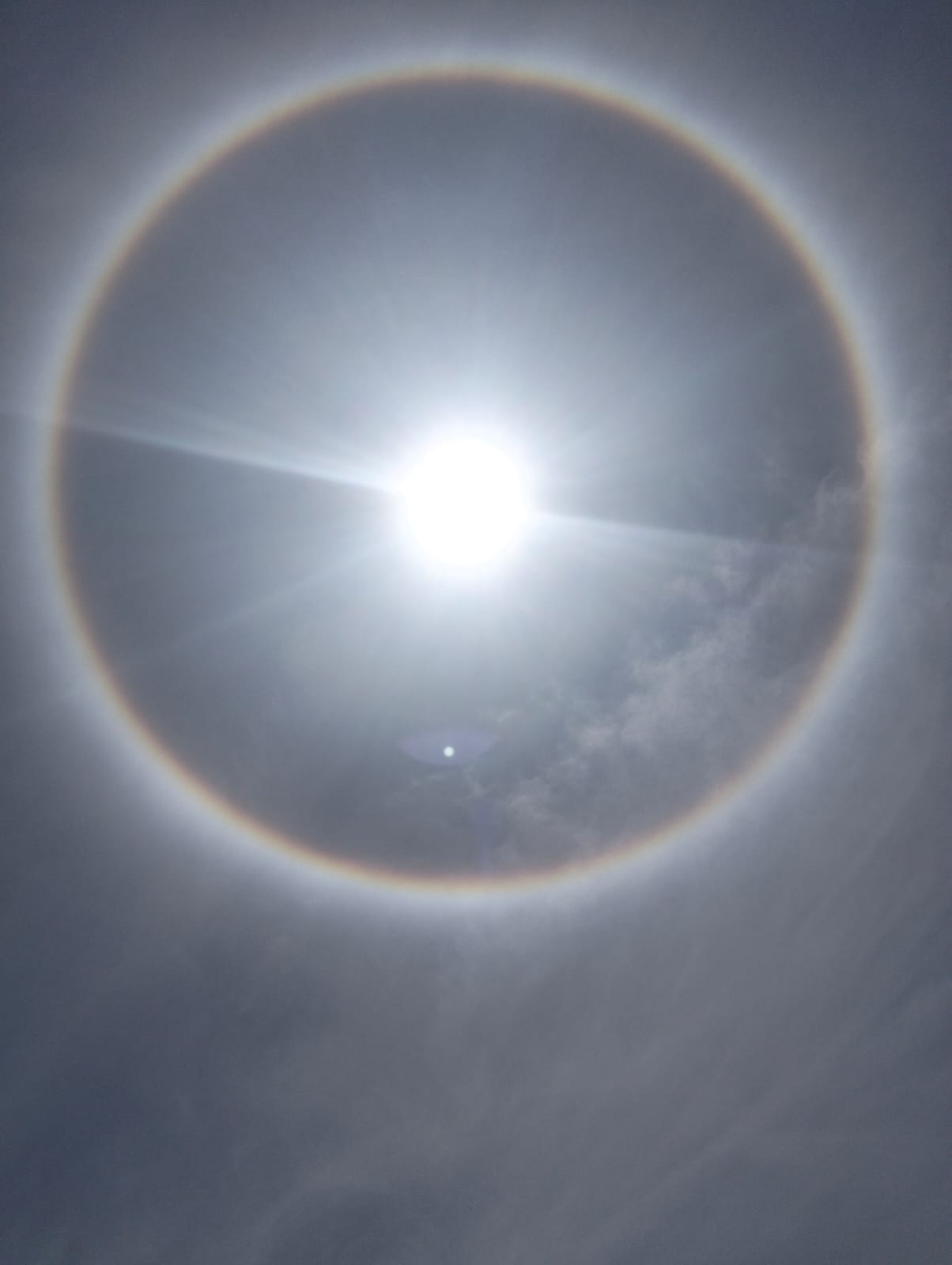
For a while on Monday morning, much of Gauteng forgot the traffic and looked up.
A wide, bright ring formed around the sun over Johannesburg, with sightings shared from Pretoria at about 11.15am and from the Hartbeespoort area. Some saw a faint wash of colour on its edge: a reddish inner rim fading to blue on the outside. Phones came out in office car parks, school grounds and backyards across the province.
What they were seeing is called a 22-degree halo, one of the most common optical displays in the sky, and one of the most striking when it appears clearly.
How the ring forms
The halo is made by ice, not sunshine alone. High above the ground, often more than 6,000 metres up, thin, wispy cirrus clouds are made of tiny hexagonal ice crystals rather than water droplets. When sunlight passes through those crystals, it bends, much as light does through a prism.
Because of the shape of the crystals, most of that light bends by about 22 degrees. Millions of crystals scattered across the sky all do the same thing, and together they light up a circle with a radius of roughly 22 degrees around the sun. That is about the width of an outstretched hand, from thumb tip to little finger, held at arm's length.
The sky just inside the ring often looks darker than the sky outside it, because very little light is bent at angles smaller than 22 degrees. The same effect can form around the moon at night.
Does it mean rain?
Old weather lore says a ring around the sun or moon means rain is coming, and there is some logic to it. Cirrus clouds can drift in ahead of an approaching weather system, so a halo sometimes shows up a day or so before cloud thickens and rain arrives.
But it is a hint, not a forecast. Cirrus also passes overhead without bringing any change at all, and forecasters have said in the past that a halo on its own tells you little about the weather to come. Check the South African Weather Service forecast before you cancel your plans.
Seeing it safely
The one rule that matters: never look straight at the sun, even with a halo around it. To see the ring, or to photograph it, stand so a building, tree or lamp post blocks the sun itself, then look at the ring around it. Wide-angle phone cameras capture the whole circle best.
Did you photograph Monday's halo? Send your pictures to The Insight Factor.
References
- The National: "Joburg's sky puts on a show: What causes the mysterious ring around the sun?" https://thenational.co.za/news/2026-11-16-joburg-s-sky-puts-on-a-show-what-causes-the-mysterious-ring-around-the-sun/
- Kormorant: "Spectacular sun halo appears over Hartbeespoort" https://kormorant.co.za/sun-halo-hartbeespoort-november-2026/
- North Coast Courier: "What is a sun halo? Rare atmospheric phenomenon seen over Ballito" (SAWS explanation) https://www.citizen.co.za/north-coast-courier/news-headlines/local-news/2025/11/27/what-is-a-sun-halo-rare-atmospheric-phenomenon-seen-over-ballito/
- News24: "Johannesburg sun halo explained" https://www.news24.com/scitech/news/johannesburg-sun-halo-explained-20101101